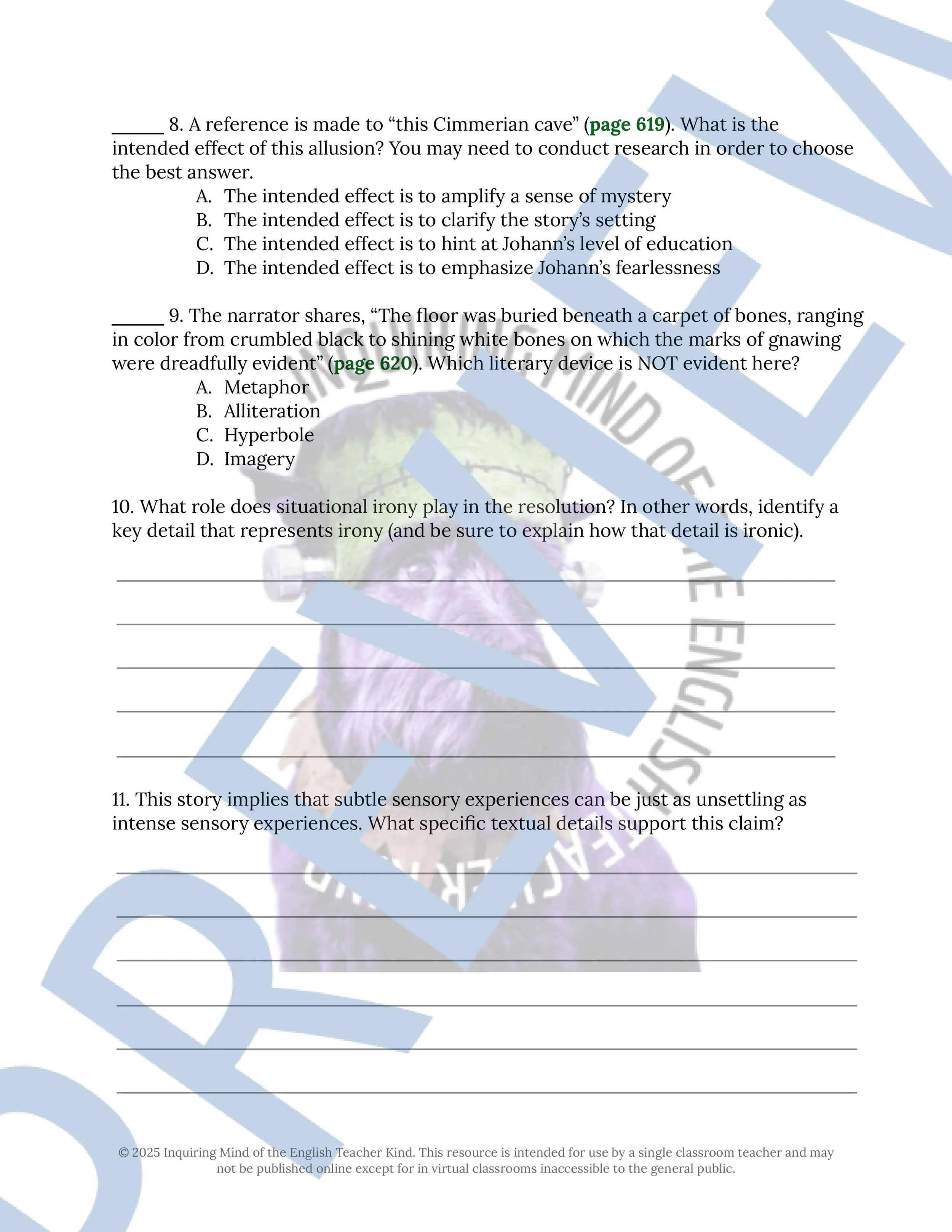
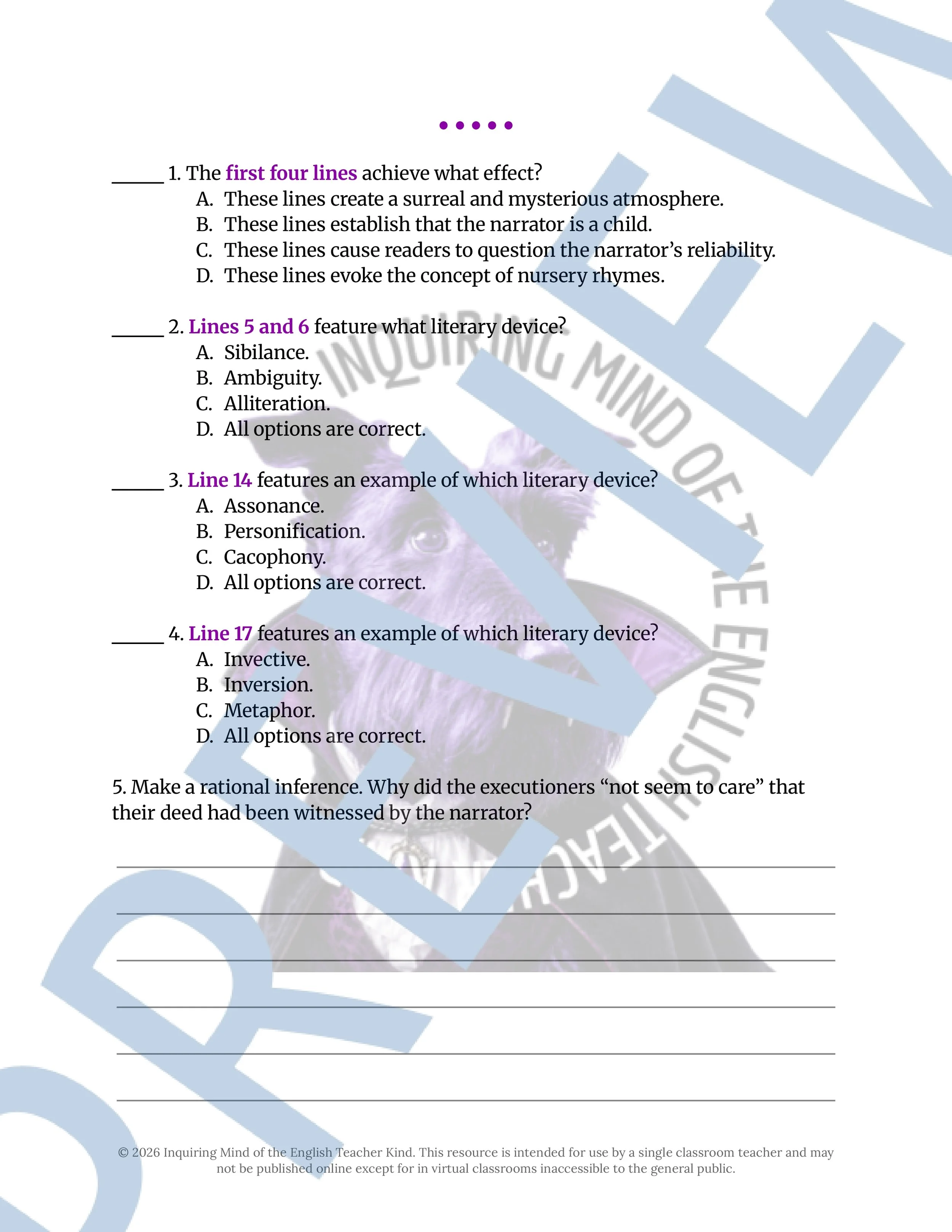
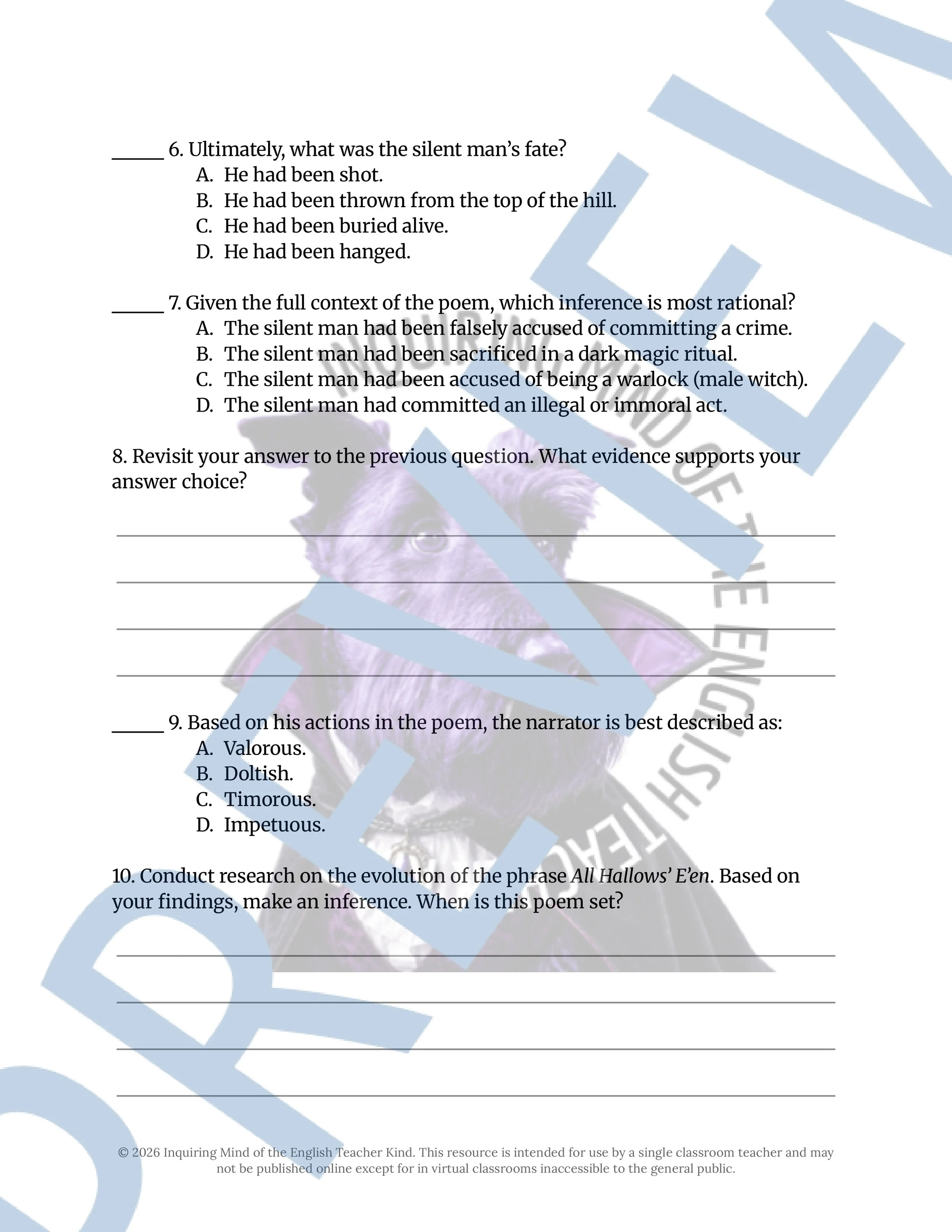
Ideal for short poetry units covering the Gothic/Dark Romanticism genre (especially around Halloween), this poem analysis worksheet helps high school readers interpret "To a Skull on My Bookshelf" by Elizabeth Virginia Raplee, a meditative piece in which the narrator faces her mortality and has an epiphany related to the possible fate of her own skeletal remains. An answer key is included. By engaging with this poetry activity, students will:
Define words as they are used in context (e.g., strangely).
Navigate connotative associations of words (e.g., relic and sardonic).
Demonstrate awareness of poetic structures.
Interpret figurative expressions (e.g., "dominates the room").
Apply knowledge of literary devices (e.g., euphemism, metaphor, and more).
Make evidence-based inferences about characterization.
Articulate a shift in focus between two stanzas.
Infer the symbolism associated with an object (e.g., the skull).
Consider themes in context.
Support claims and inferences with sound reasoning and relevant evidence.
Materials are delivered in editable Word Document and printable PDF formats. (Alternatively, a Google option is available.)
More Weird Tales resources for the Halloween season are available:
Ideal for short poetry units covering the Gothic/Dark Romanticism genre (especially around Halloween), this poem analysis worksheet helps high school readers interpret "To a Skull on My Bookshelf" by Elizabeth Virginia Raplee, a meditative piece in which the narrator faces her mortality and has an epiphany related to the possible fate of her own skeletal remains. An answer key is included. By engaging with this poetry activity, students will:
Define words as they are used in context (e.g., strangely).
Navigate connotative associations of words (e.g., relic and sardonic).
Demonstrate awareness of poetic structures.
Interpret figurative expressions (e.g., "dominates the room").
Apply knowledge of literary devices (e.g., euphemism, metaphor, and more).
Make evidence-based inferences about characterization.
Articulate a shift in focus between two stanzas.
Infer the symbolism associated with an object (e.g., the skull).
Consider themes in context.
Support claims and inferences with sound reasoning and relevant evidence.
Materials are delivered in editable Word Document and printable PDF formats. (Alternatively, a Google option is available.)
More Weird Tales resources for the Halloween season are available:

 Image 1 of 5
 Image 2 of 5
 Image 3 of 5
 Image 4 of 5
 Image 5 of 5